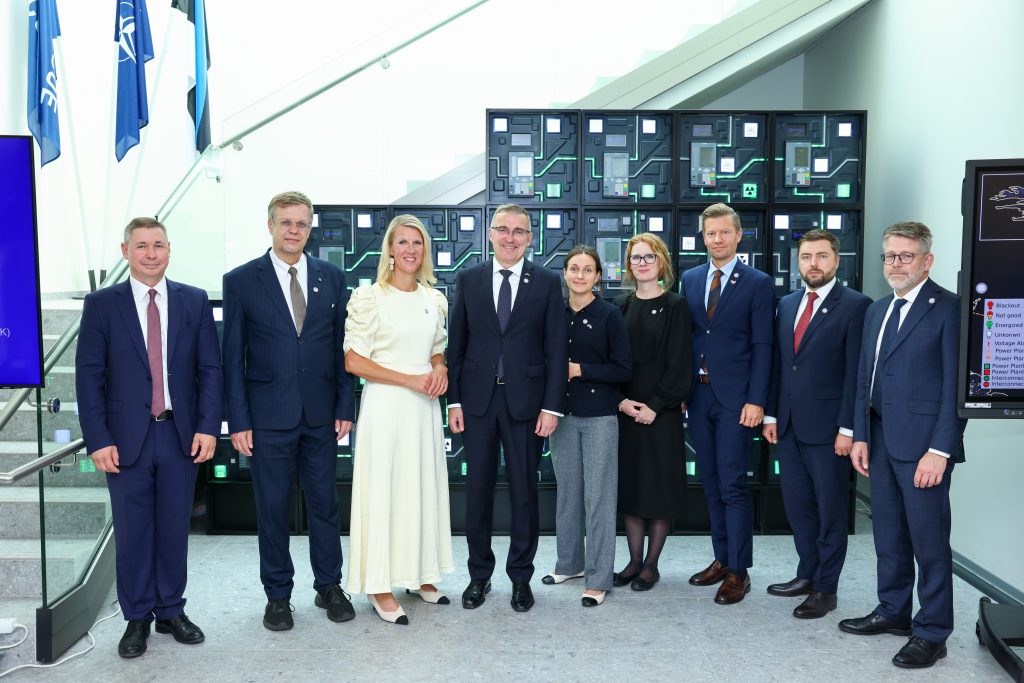
Nordic-Baltic 8 energy ministers and senior officials visited the NATO Cooperative Cyber Defence Centre of Excellence (NATO CCDCOE) in Tallinn on 4 September, where they explored the role of cyber defence in protecting critical energy infrastructure and took part in a tabletop exercise built around a fictional regional electricity crisis.
The visit took place as part of the Nordic-Baltic (NB8) Energy Ministers’ meeting held in Tallinn on 3–4 September under Estonia’s 2026 NB8 Presidency, with Ukraine also participating.
At NATO CCDCOE, the delegation was welcomed by Director Tõnis Saar. The participants were introduced to the Centre’s work in strengthening cyber defence cooperation and received a demonstration of its power grid range, a specialised environment used to simulate energy infrastructure and support realistic cyber defence training, including during NATO CCDCOE’s flagship exercises.
As a part of the Ministers’ programme, CCDCOE provided a tabletop exercise focusing on the resilience of the Nordic-Baltic electricity system. The fictional scenario placed participants in a cross-border electricity supply crisis in which the cause of the disruption had not been established and national assessments of the situation differed.
The exercise challenged participants to consider how the eight Nordic-Baltic countries could develop a shared understanding of a rapidly evolving situation, establish a common position and identify the practical arrangements needed for coordinated action. The scenario also introduced a cyber dimension involving malicious activity originating from infrastructure outside the participating countries’ jurisdictions.
The scenario reflected the increasingly interconnected nature of energy security and cyber defence. One of the main outcomes was a shared understanding, that cross-border energy systems depend on close cooperation, information sharing and coordinated decision-making, particularly when the source and nature of a disruption are initially unclear.
The broader NB8 Energy Ministers’ meeting focused on supporting Ukraine’s energy supply ahead of the coming winter, protecting energy infrastructure in the Baltic Sea region, strengthening the resilience of energy systems and fostering a competitive Baltic Sea energy market.