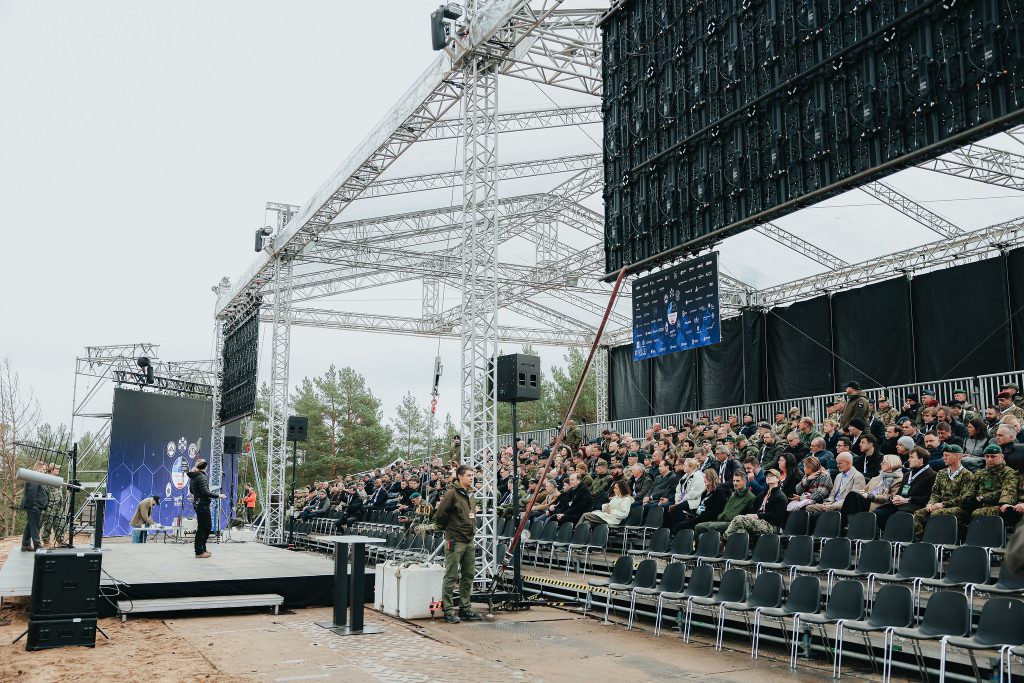
NATO’s Digital Backbone eXperimentation (DiBaX 2026) took place in Latvia from 19 to 30 October under the leadership of NATO Allied Command Transformation (ACT). It brought together participants from 22 Allied nations and more than 60 industry partners. For the third year, the NATO Cooperative Cyber Defence Centre of Excellence (CCDCOE) supported the experiment, providing core networking functions to enable military use cases.
DiBaX is a NATO field-based event for testing digital backbone technologies and improving interoperability in operationally relevant conditions. This year, communications experimentation focused on three areas: rapid deployment using 5G network slicing; resilient communications, including failover between different communication methods; and passive object detection using 5G infrastructure. The experiments examined how different technologies, networks and systems could work together to support NATO operations.
The CCDCOE researchers and 5G testbed supported the experiments with roaming capabilities and integration of tactical radios with 5G system components.“CCDCOE’s contribution focused on the digital backbone, which enables multinational collaboration across interconnected 5G networks. This year, we concentrated on integrating tactical radios in different configurations with 5G system components. We also provided components of a connectivity platform for the experiments use,” said Mattias Männi, NATO CCDCOE 5G Program Manager.
“We are particularly proud of this year’s results. Experimentation naturally involves the possibility of failure. We set ourselves complex challenges and worked with production-grade systems, where the scope for custom configurations can be limited. Yet none of the experiments failed,” Männi added.
NATO CCDCOE continues its 5G research and integrates 5G system components into its flagship exercises, Locked Shields and Crossed Swords.
📷 Photos: Latvian National Armed Forces